Key Points in This Chapter
- An annuity is a stream of periodic payments — a vehicle for liquidating a sum of money over time, with interest
- Only life insurance companies can guarantee annuity payments for life, using the survivorship factor derived from mortality tables
- Annuities are the mirror image of life insurance: life insurance creates an estate; annuities liquidate one
- Two distinct time periods: the accumulation period (premiums paid in, interest credited) and the annuity period (income paid out)
- Three required parties: contractholder, annuity company, and annuitant; a fourth optional party is the beneficiary
- Premium funding options: single premium (lump sum) or periodic premiums (installment or flexible)
- Immediate annuities begin income within one payment interval; deferred annuities accumulate for a future date
- Surrender charges typically apply during the first 5–8 years of a deferred annuity; the IRS also imposes a 10% penalty on withdrawals before age 59½
- Annuitization converts a deferred contract from an investment vehicle to an income-paying device; once annuitized, the contractholder loses control
The Nature of Annuities
An annuity is a stream of periodic payments. Start with a lump sum of money, pay it out in equal installments over a period of time until the original fund is exhausted, and you have created an annuity. An annuity is simply a vehicle for liquidating a sum of money. Of course, in practice the concept is more complex. An important factor is interest — the sum of money that has not yet been paid out is earning interest, and that interest will eventually pass on to the recipient.
Anyone can provide an annuity. Insurance companies provide lifetime annuities to retirees. A homebuyer provides a mortgage company with an annuity as she pays off monthly mortgage payments; likewise, those purchasing cars and other goods on an installment plan are in effect paying out an annuity. By knowing the original sum of money (the principal), the length of the payout period, and an assumed rate of interest, it is fairly simple to calculate the payment amount. Actuaries have constructed tables of annuity factors — “present value interest factors for a $1 annuity” — that make this process even easier.
Present Value Interest Factors — $1 Annuity
Swipe the table sideways to see all rates →
| Years | 7% | 7.5% | 8% | 8.5% |
|---|---|---|---|---|
| 1 | $0.934579 | $0.930233 | $0.925926 | $0.921659 |
| 2 | $1.808018 | $1.795565 | $1.783265 | $1.771114 |
| 3 | $2.624316 | $2.600526 | $2.577097 | $2.554022 |
| 4 | $3.387211 | $3.349326 | $3.312127 | $3.275597 |
| 5 | $4.100197 | $4.045885 | $3.992710 | $3.940642 |
| 6 | $4.766540 | $4.693846 | $4.622880 | $4.553587 |
| 7 | $5.389289 | $5.296601 | $5.206370 | $5.118514 |
| 8 | $5.971299 | $5.857304 | $5.746639 | $5.639183 |
| 9 | $6.515232 | $6.378887 | $6.246888 | $6.119063 |
| 10 | $7.023582 | $6.864081 | $6.710081 | $6.561348 |
| 15 | $9.107914 | $8.827120 | $8.559479 | $8.304237 |
| 20 | $10.594014 | $10.194491 | $9.818147 | $9.463337 |
The table above displays present value interest factors for annual payments of $1 lasting various periods of time at different interest rates. For example, the factor for ten annual payments of $1 at 8% interest is $6.71. This means that if a person set aside $6.71 and earned 8% interest while the fund was being depleted, an annual income of $1 could be paid for 10 years — receiving a total of $10 for the original $6.71 invested, with the difference representing interest collected over 10 years.
Actuaries have calculated similar tables for different rates of interest and for related problems — such as how long payments can continue for any given amount of principal. With modern financial calculators, these values can be found without tables; but the basic underlying principle is the same: the amount of an annuity payment is dependent upon three factors: starting principal, interest rate, and payment period.
These tables work well for calculating fixed-period payments (a 30-year mortgage, a 5-year car loan), but are not as useful for determining lifetime income for a 65-year-old retiree — for that, one needs to know life expectancy. Life insurance companies, because of their experience with mortality tables, are uniquely qualified to combine an extra factor — called the survivorship factor — into the standard annuity calculation. The survivorship factor is the mirror image of the mortality factor in life insurance. While anyone can set up an annuity and pay income for a stated period of time, only life insurance companies can guarantee a lifetime of income for the annuitant.
Annuities vs. Life Insurance
While life insurance companies issue annuities, it is important to note that annuities are not life insurance contracts. Annuities are best described as the mirror image of a life insurance contract — they look alike but are actually exact opposites:
- The principal function of a life insurance contract is to accumulate a sum of money by the periodic payment of premiums into the contract (“creating an estate”). An annuity’s principal function is to liquidate an estate by the periodic payment of money out of the contract.
- Life insurance is concerned with how soon one will die; life annuities are concerned with how long one will live.
- Life insurance uses a mortality factor; annuities employ a survivorship factor.
- One purchases life insurance to protect against dying “too soon”; one buys an annuity to protect against living “too long.”
It is easy to see how annuities can meet important financial needs. Their role in retirement planning should be obvious — guaranteeing that an annuitant cannot outlive payments from a life annuity has brought peace of mind to many people over the years. Annuities can play a vital role in any financial plan where a stream of income is needed, whether for a few years or for a lifetime.
Accumulation Period vs. Annuity Period
Individuals may purchase annuities with a single sum or through periodic payments. The insurer credits the annuity fund with a rate of interest, which is not currently taxable. Over time, the value of the annuity grows. The ultimate amount available for payout reflects both the amount paid into the contract and the interest credited. Most annuities guarantee a death benefit in the event the annuitant dies before payout begins, usually limited to the amount paid in plus credited interest.
With any annuity, there are two distinct time periods:
Accumulation Period
The accumulation period is the time during which the contractholder pays premiums into the annuity and the insurer credits interest earnings to the contract. During this period, the contractholder retains control: withdrawing funds, surrendering the contract, or exchanging it for a different type. The contract details what rights the contractholder has and any limitations. The accumulation period can last for years, or may be momentary (as with an immediate annuity).
Annuity Period
During the annuity period, the insurer pays periodic payments to the recipient. The conversion from accumulation to annuity period is called annuitization — the contract turns from an investment vehicle to an income-paying device. The contractholder chooses how payments will be paid out; typically monthly, though quarterly, semiannual, or annual payouts are possible.
In some contracts there is no requirement that the contract ever be annuitized — the accumulation period may continue indefinitely. Other contracts may require annuitization by a certain date or age (often called the contract’s starting date or maturity date), though many allow the owner to extend the accumulation period by written notice. Once annuitized, the contractholder loses control of the account, and the company simply pays the income payments selected.
Parties to an Annuity Contract
There are at least three parties to an annuity contract:
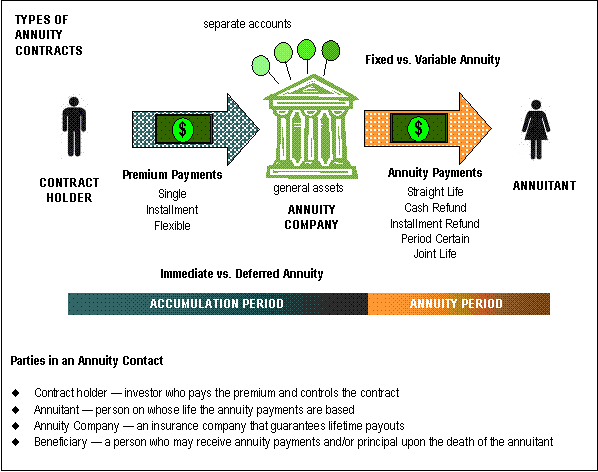
Structure & Design of Annuity Contracts
There are many ways to describe annuities, based on different design factors:
- How will money be added to the contract? The contractholder may pay a single premium or periodic payments.
- When will payments be paid out? Some contracts begin income immediately; others defer income payments into the future.
- How long will payments last? Annuity contracts offer payout options for a stated period of years or, more commonly, for a lifetime.
- How does the company invest the funds? In some contracts, funds are held in the company’s general account with a guaranteed fixed rate; in others, funds are invested in a separate account with variable returns.
Premium Payments
An annuity begins with a sum of money called the principal. Annuity principal is created in one of two ways:
Single Premium
Annuities can be funded with a single lump-sum premium, creating the principal immediately. For example, an employee could use the accumulated value of a 401(k) plan at retirement to fund the purchase of an annuity providing retirement income. Insurance companies also commonly use a life insurance policy’s death benefit to purchase a single premium annuity as a life income settlement option.
Periodic Premiums
Annuities can also be funded through a series of periodic premiums that, over time, create the annuity principal fund. In the past, insurers required fixed and level installment premiums, much like traditional life insurance premiums — allowing the company to guarantee future values at inception.
Today, insurers often allow annuity owners to make flexible premium payments. A minimum premium is required to purchase the annuity, but after that the owner can make premium deposits as often as desired — analogous to the premium flexibility of universal life insurance.
Immediate vs. Deferred Annuities
Annuities can be classified by when income payments to the annuitant begin:
Immediate Annuities
An immediate annuity makes its first benefit payment to the annuitant at one payment interval from the date of purchase. Since most annuities pay monthly, an immediate annuity typically pays its first payment one month from the purchase date. Immediate annuities have no real accumulation period — the annuity period begins at inception.
Immediate annuities must be funded with a single payment, and are often called single-premium immediate annuities (SPIAs). An annuity cannot simultaneously accept periodic funding payments and pay out annuity income.
Deferred Annuities
A deferred annuity delays the start of income payments to some future date. Unlike immediate annuities, deferred annuities can be funded with periodic payments over time — commonly called flexible premium deferred annuities (FPDAs). Deferred annuities funded with single premiums are called single-premium deferred annuities (SPDAs).
Deferred annuities have an accumulation period during which the contractholder retains important rights: surrendering the contract, withdrawing funds, and exchanging the contract for a more suitable one. Most insurers charge surrender charges for withdrawal or surrender in the early years of the contract — typically a sliding scale over the first 5–8 years, with most contracts waiving charges on small withdrawals (up to 10% of annuity value annually). In addition to contract surrender charges, the IRS imposes a 10% penalty on withdrawals before age 59½. Unlike qualified retirement plans, withdrawals from non-qualified deferred annuities are not subject to required minimum distributions. For annuities held inside qualified retirement accounts, RMDs must begin at age 73 (under current SECURE 2.0 rules).
Annuitization is the decision to start receiving periodic annuity payments. Once made, the contractholder loses control of the contract and the company pays the promised income. While some contracts specify the annuity starting date at inception, most deferred contracts leave the decision to annuitize to the contractholder — and many annuity contracts continue indefinitely in the accumulation period, never annuitizing.