Payout Options — How Long Will Annuity Payments Last?
Annuitants have numerous payout options. As discussed earlier, the amount of each annuity payment is based on three factors: principal, interest, and the length of the payout period. So the size of each payout obviously depends on the amount accumulated in the contract. In the case of lifetime payouts, payment size also depends on the life expectancy (or survivorship factor) of the annuitant. All other factors being equal, younger annuitants with a longer life expectancy will receive smaller annuity payments than a person annuitizing an equal amount at an older age. Likewise, women, who have longer life expectancies than men, will be paid smaller annuity payments (unless the company uses “unisex” survivorship factors).
Another factor the company will consider is whether the payout method provides for possible continued payments to a beneficiary. These payout options may extend the payout period past the annuitant’s lifetime and consequently result in lower periodic payments.
Please note that the size of future annuity payments is calculated when the account is “annuitized.” Deferred annuities typically offer the contractholder guaranteed minimum payouts at the contract’s inception, but in many cases, the company will offer more advantageous “current” payouts when the contract is actually annuitized. And as discussed later in this course, the contractholder can exchange the current contract for another contract that offers better payout options — and then annuitize the new contract. Once the payout method is selected, the size of the income payments will not change in the future (or in the case of variable annuities, discussed below, the number of annuity units remains fixed).
Contractholders may choose among a number of annuity income options: straight life income, cash refund, installment refund, life with period certain, joint and survivor, and annuities for a specified period.
A straight life income annuity (often called a life annuity or straight life annuity) pays the annuitant a guaranteed income for his or her lifetime. When the annuitant dies, no further payments are made to anyone. If the annuitant dies before the annuity fund (the principal) is depleted, the balance, in effect, is “forfeited” to the insurer. The company uses the forfeited balance to provide payments to other annuitants who outlive their life expectancies. Companies rely on “risk pooling” and the “Law of Large Numbers” when constructing annuity contracts — just as they do when they underwrite life insurance.
Of all the payout options, straight life pays the highest monthly income payments, all other factors being equal. This is because the insurance company has the possibility of retaining the “forfeited” funds. All of the following options provide for additional payouts to beneficiaries, and therefore will pay slightly lower monthly payments than the straight life option.

A cash refund option provides a guaranteed income to the annuitant for life and, if the annuitant dies before the annuity fund (the principal) is depleted, a lump-sum cash payment of the remainder is made to the annuitant’s beneficiary. Thus, the beneficiary receives an amount equal to the beginning annuity fund less any principal payments already made to the deceased annuitant.

The installment refund option, like the cash refund, guarantees that the total annuity fund will be paid to the annuitant or to his or her beneficiary. The difference is that under the installment option, the fund remaining at the annuitant’s death is paid to the beneficiary in the form of continued annuity payments, not as a single lump sum.
Under either the cash refund or installment refund option, if the annuitant lives long enough to receive payments equal to the principal amount, no future payments will be made to a beneficiary.

The “life with period certain” option, also known as “life income with term certain,” is designed to pay the annuitant an income for life, but guarantees a definite minimum period of payments. For example, if Janice selects a life and 15-year certain annuity, she is guaranteed payments for life or fifteen years, whichever is longer. If Janice receives monthly payments for seven years and then dies, her beneficiary will receive the same payments for eight more years. Of course, if she dies after receiving monthly annuity payments for 15 or more years, her beneficiary would receive nothing from the annuity. The contractholder may select any timeframe for the “period certain”, with 10 and 15 years being most common.
Annuities with longer “periods certain” have lower monthly payments, all other factors being equal. If Janice had picked a 10-year period certain instead of 15 years, her monthly payments would be slightly larger. In other words, additional protection for her beneficiary comes at a cost.

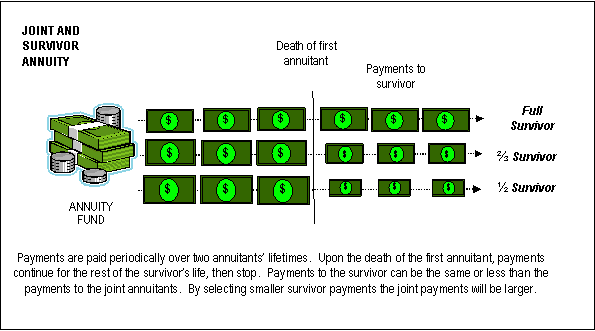
The joint and full survivor option provides for payment of the annuity to two people. If either person dies, the same income payments continue to the survivor for life. When the survivor dies, no further payments are made to anyone. This is a popular way for married couples to guarantee income for both spouses regardless of who may die first.
Often, a couple might reason that living expenses will be less upon the death of one spouse. They might select a reduced payout for the survivor. Joint and two-thirds survivor payouts reduce the survivor’s income to two-thirds of the original joint income; joint and one-half survivor plans reduce the survivor’s payout to one-half of the original joint income. The advantage of these reduced survivor payouts is that the joint payouts — while both annuitants are alive — will be higher. Put another way, the larger the guarantee to the survivor, the smaller the joint payout when both are alive.
While lifetime annuities are a preferred method for paying out benefits, annuities can be structured for a specific number of years rather than a lifetime. Structured settlements (legal judgments payable over time) and lottery prizes are examples of an “annuity for a period certain.” Any period is possible, with terms of 10, 15, or 20 years being common. At the end of the specified term, payments cease.
It may seem obvious, but contractholders who do not have a life expectancy may not select a lifetime payout. Contractholders such as corporations and charities must select an “annuity for a specific period.”
Representative Annuity Payout Tables
The following tables show representative sample payout rates based on interest at 3½% per year. Actual rates will vary by insurer and prevailing interest rate environment at the time of annuitization.
Payments for a Specified Number of Years (per $1,000)
Swipe the table sideways to see all columns →
| PAYMENTS FOR SPECIFIED NUMBER OF YEARS — payments per $1,000 based on interest at 3½% per year | ||||
|---|---|---|---|---|
| YEARS | ANNUAL | SEMI-ANNUAL | QUARTERLY | MONTHLY |
| 5 | $213.99 | $107.92 | $54.19 | $18.12 |
| 10 | $116.18 | $58.59 | $29.42 | $9.83 |
| 15 | $83.89 | $42.31 | $21.24 | $7.10 |
| 20 | $67.98 | $34.28 | $17.22 | $5.75 |
| 25 | $58.62 | $29.56 | $14.86 | $4.96 |
| 30 | $52.53 | $26.43 | $13.30 | $4.45 |
Monthly Lifetime Payments (per $1,000)
Swipe the table sideways to see all columns →
| MONTHLY LIFETIME PAYMENTS — payments per $1,000 based on interest at 3½% per year | |||||
|---|---|---|---|---|---|
| AGE | LIFE ANNUITY | INSTALLMENT REFUND | 5-YEAR CERTAIN | 10-YEAR CERTAIN | 15-YEAR CERTAIN |
| 10 | $3.14 | $3.13 | $3.14 | $3.14 | $3.14 |
| 20 | $3.26 | $3.25 | $3.26 | $3.26 | $3.25 |
| 30 | $3.44 | $3.33 | $3.34 | $3.34 | $3.33 |
| 40 | $3.73 | $3.69 | $3.73 | $3.72 | $3.70 |
| 50 | $4.19 | $4.10 | $4.19 | $4.17 | $4.10 |
| 60 | $4.98 | $4.75 | $4.96 | $4.90 | $4.66 |
| 61 | $5.09 | $4.83 | $5.07 | $5.00 | $4.73 |
| 62 | $5.20 | $4.92 | $5.18 | $5.10 | $4.79 |
| 63 | $5.32 | $5.02 | $5.30 | $5.21 | $4.86 |
| 64 | $5.46 | $5.12 | $5.42 | $5.33 | $4.93 |
| 65 | $5.60 | $5.22 | $5.56 | $5.44 | $4.99 |
| 66 | $5.74 | $5.33 | $5.70 | $5.57 | $5.06 |
| 67 | $5.90 | $5.45 | $5.85 | $5.70 | $5.12 |
| 68 | $6.07 | $5.57 | $6.02 | $5.84 | $5.18 |
| 69 | $6.26 | $5.70 | $6.19 | $5.98 | $5.24 |
| 70 | $6.45 | $5.84 | $6.37 | $6.13 | $5.30 |
| 75 | $7.68 | $6.65 | $7.48 | $6.97 | $5.53 |
| 80 | $9.43 | $7.71 | $8.98 | $7.87 | $5.67 |
Joint and Full Survivor — Monthly Payments (per $1,000)
Swipe the table sideways to see all columns →
| JOINT AND FULL SURVIVOR — monthly payments per $1,000 based on interest at 3½% per year | |||||||
|---|---|---|---|---|---|---|---|
| AGE | 50 | 55 | 60 | 65 | 70 | 75 | 80 |
| 50 | $3.70 | $3.77 | $3.82 | $3.86 | $3.89 | $3.91 | $3.93 |
| 55 | — | $3.92 | $4.01 | $4.08 | $4.14 | $4.17 | $4.20 |
| 60 | — | — | $4.22 | $4.34 | $4.43 | $4.50 | $4.54 |
| 65 | — | — | — | $4.61 | $4.77 | $4.90 | $4.98 |
| 70 | — | — | — | — | $5.16 | $5.38 | $5.54 |
| 75 | — | — | — | — | — | $5.92 | $6.23 |
| 80 | — | — | — | — | — | — | $7.00 |
Joint and One-Half Survivor — Monthly Payments (per $1,000)
Swipe the table sideways to see all columns →
| JOINT AND ONE-HALF SURVIVOR — monthly payments per $1,000 based on interest at 3½% per year | |||||||
|---|---|---|---|---|---|---|---|
| AGE | 50 | 55 | 60 | 65 | 70 | 75 | 80 |
| 50 | $4.22 | $4.29 | $4.60 | $4.85 | $5.14 | $5.47 | $5.83 |
| 55 | — | $4.56 | $4.79 | $5.06 | $5.38 | $5.74 | $6.13 |
| 60 | — | — | $5.02 | $5.32 | $5.68 | $6.09 | $6.52 |
| 65 | — | — | — | $5.65 | $6.05 | $6.51 | $7.02 |
| 70 | — | — | — | — | $6.52 | $7.05 | $7.65 |
| 75 | — | — | — | — | — | $7.75 | $8.48 |
| 80 | — | — | — | — | — | — | $9.52 |
Straight life: $5.60 × 100 = $560/month
Installment refund: $5.22 × 100 = $522/month
5-year certain: $5.56 × 100 = $556/month
10-year certain: $5.44 × 100 = $544/month
20-year certain: $4.99 × 100 = $499/month
Joint & full survivor (with 60-year-old spouse): $4.34 × 100 = $434/month
Joint & one-half survivor (with 60-year-old spouse): $5.32 × 100 = $532/month
Monthly payments lasting 5 years: $18.12 × 100 = $1,812/month
Monthly payments lasting 10 years: $9.83 × 100 = $983/month
Monthly payments lasting 15 years: $7.10 × 100 = $710/month
Fixed Annuities
Annuities can also be defined according to their investment configuration, which affects the income benefits they pay. Two major classifications are fixed annuities, which provide a fixed, guaranteed accumulation or payout, and variable annuities, which attempt to offset inflation by providing a benefit linked to a variable underlying investment account. A third option, equity-indexed annuities, is fairly new but has become quite popular. Equity-indexed annuities combine features of fixed and variable annuities.
Fixed annuities provide a guaranteed minimum rate of return. The contractholder’s contributions are placed in the general assets of the annuity company, which invests these payments in conservative, long-term securities (typically bonds). This allows the company to credit a steady interest rate to the annuity contract. The interest payable for any given year is declared in advance by the insurer and is guaranteed to be no less than a minimum specified in the contract. So a fixed annuity has two interest rates: a minimum guaranteed rate and a current rate.
Current Interest Rate
Each annuity company credits the fixed contract with the current rate on a regular schedule, typically each year, but that rate cannot be less than the minimum guaranteed rate. Some contracts guarantee a rate of interest (higher than the minimum rate) for the first years of the contract, after which the current declared rate applies. There are four basic methods annuity companies use to apply the current interest rate to the contract:
Bail-Out Rate and CD Annuity
Some fixed deferred annuities offer a “bail-out” rate. If the renewal rate drops below the bail-out rate, the company will waive any surrender charges — allowing the contractholder to exit the annuity position and seek higher-yielding investments without paying a contract penalty.
Another variation is the “CD Annuity,” designed as an alternative to bank certificates of deposit. This type of contract guarantees its initial rate of interest during the surrender charge period (typically the first six years of the contract, or less), with no surrender charges if held to “maturity.” Deferred annuity holders under age 59½ may still face an IRS early withdrawal penalty if they exit early or if the CD Annuity matures while they are still under age 59½.
Bonus Interest Rate
One popular feature available in some deferred annuities is the “bonus” interest rate — a rate credited over and above the current renewal rate for deposits made in the first year or first few years of the contract. The bonus interest is immediately vested with the contractholder; there are no strings attached to the extra interest. Companies use the bonus to encourage additional premium contributions.
While bonus interest sounds attractive, this incentive comes at a cost. Surrender charges on bonus contracts may be higher, interest rate guarantees may be lower, or a less advantageous interest crediting method might be used. As always, there are no free lunches. Some companies use the same principle to encourage annuitization rather than surrender or withdrawals — extra interest is credited to the contract if it is annuitized.
Annuitization of Fixed Contracts
When the contract is annuitized, a fixed annuity provides guaranteed income payments of a fixed amount based on the payout method selected by the contractholder. The contract will usually display possible payouts in terms of dollars per $1,000 of accumulated value.