Variable Annuities
From the contract owner’s point of view, the accumulation of funds in a fixed annuity is certain and the contract owner’s principal is secure — the annuity company bears the investment risk. Because fixed annuities provide a specified benefit payable for life (or any other period the annuitant desires), they offer security and financial peace of mind. However, since the benefit amount is fixed, annuitants may see the purchasing power of their income payments decline over the years due to inflation. For investors concerned with inflation (or purchasing power) risk, variable annuities might be preferable.
Inflation poses a real threat to those relying on a fixed income. Even relatively modest rates of inflation can seriously erode the purchasing power of fixed income payments — at 4% inflation, prices will double in less than 20 years. What once seemed an adequate retirement income may no longer maintain an adequate standard of living. In the early 1950s, an association representing teachers reviewed the fixed annuity assumptions of their pension plan and, to address inflation risk, developed the concept of a variable annuity.
Variable annuities shift the investment risk from the insurer to the contract owner. If the investments supporting the contract perform well (as in a “bull market”), the owner will probably realize investment growth that exceeds what is possible in a fixed annuity. However, the lack of an investment guarantee means that the variable annuity owner can see the value of his or her annuity decrease in a depressed market or in an economic recession.
Separate Account
The distinguishing feature of a variable annuity is the “separate account”, also called the “subaccount.” The contractholder’s premium contributions are credited to a separate investment account — not the annuity company’s general account. Historically, separate accounts invested in securities designed to protect against inflation, primarily common stocks. Today, most annuity companies offer a wide variety of investment options ranging from money market funds to real estate-backed securities. Most contracts also offer the variable contractholder a “fixed” investment alternative, which mimics the guaranteed interest rate of a fixed annuity.
Some companies offer only “proprietary” separate accounts managed by their in-house investment advisors; other companies employ outside money managers, often the same managers that offer mutual funds to the public. Contractholders may choose to diversify their investments by directing their premiums into a variety of separate accounts, and many companies offer services to periodically reallocate investments to maintain desired investment balance. The contract owner may also switch investments from one separate account to another at little or no cost as market conditions change.
During the accumulation period, the value of the contract will vary according to the investment results in the separate account(s). When the contract is annuitized and annuity payments begin, the size of those payments will also be based on the investment results of the separate account — exposing the annuitant to investment risk. Variable annuity payments are subject to changing market conditions, but that was the intent of variable annuities in the first place.
Stocks vs. Bonds: The Inflation Argument
Equity investments, such as common stocks, represent shares of business ownership, and they tend to change in value with changing economic conditions. The market price of a stock is set by willing buyers and sellers based on forecasts of the company’s earnings, dividends, and future growth. This contrasts with debt instruments such as bonds, which carry a fixed rate of return. The value of a bond depends more on its interest rate relative to other debt obligations than on the growth of the issuing company; bonds also have a fixed maturity date. The anticipation of eventual repayment tends to keep bond prices more stable than stock prices — but bonds are also very susceptible to inflation risk.
There are no guarantees that common stock prices will keep pace with inflation, but in general, over long periods of time, that has been the trend. It is important to note that in the long term, stock prices tend to keep pace with general price levels, but this is not necessarily the case in the short term. No investment, including a variable annuity, is a perfect inflation hedge during all economic periods.
Regulation of Variable Annuities
Variable annuities are based on non-guaranteed equity investments such as common stocks. When first introduced, the Securities and Exchange Commission (SEC) asserted control over these products as “securities” — and the Supreme Court concurred. So variable annuities are subject to dual regulation: at the state level as an insurance product, and at the federal level as a security. In Florida, companies issuing annuities, fixed or variable, fall under the jurisdiction of the Office of Insurance Regulation. One requirement of the Office is that investments in a variable annuity’s separate account must have a “readily determinable value” — that is, they are marketable securities.
Insurance companies wishing to operate a separate account must register the account with the SEC as an “open end investment company” under the Investment Company Act of 1940. Mutual funds are also registered under this federal law, and it is convenient to think of separate accounts as mutual funds. Under federal law, a prospectus — a document explaining the details of the investment — must accompany all sales of mutual funds, variable insurance, and variable annuities.
To sell variable insurance products, an individual must hold a life insurance/variable annuity license granted by state authority and a registered representative’s license granted by FINRA. In Florida, agents who have fully satisfied the requirements for a life insurance license, including successful completion of a licensing exam that covers variable annuities, may sell or solicit variable annuity contracts. Since 1990, the Florida life agent examination has included variable annuities. Life agents licensed prior to 1990 did not automatically obtain the variable annuity license; a separate variable annuity examination is available for those agents. In Florida, a variable annuity license does not exist by itself — it is valid only if the agent also holds a valid life insurance agent license.
Accumulation Units & Annuity Units
To accommodate the variable concept, a new means of accounting for both annuity payments and annuity income was required. The result is the accumulation unit, which pertains to the accumulation period, and the annuity unit, which pertains to the income payout period.
Accumulation Units
During the accumulation period of a variable annuity, contributions made by the investor (less a deduction for expenses) are converted into accumulation units and credited to the selected separate account. Each additional contribution will purchase more accumulation units. The value of each accumulation unit varies depending on the value of the underlying portfolio of stocks — similar to, but not identical to, shares of a mutual fund.
One popular investment strategy, known as dollar cost averaging, applies to periodic investments of the same dollar amount — very common in flexible premium deferred annuities. By investing the same dollar amount periodically, the investor will purchase more units when the price is down, and fewer when the price is high. As a result, the average cost of the units acquired will be lower than the average price of the units over the period. In the example above, the investor purchased 25 units at $8 and 20 units at $10. The average price was $9.00, but the average cost was only $8.89 ($400 ÷ 45 units). Many variable annuity contracts offer an “automatic” dollar cost averaging program where a lump sum is placed in the fixed account and transferred monthly to the selected separate account(s) over six to twelve months.
The current value of one accumulation unit is found each business day by dividing the total value of the company’s separate account by the total number of accumulation units outstanding. As the value of the investment portfolio rises and falls, the value of each accumulation unit also rises and falls.
Many annuity companies offer a “family of separate accounts” — a collection of portfolios with varying investment objectives (conservative growth, aggressive growth, balanced, etc.). During the accumulation period, the contractholder may switch among the various accounts or allocate the premium to more than one account, providing flexibility to adjust investments as market or personal conditions change.
Annuity Units
When the investor decides it is time for benefits to be paid in monthly income payments, the accumulation units in the participant’s individual account are converted into annuity units — the contract is said to be “annuitized.” At that time, the annuity company calculates the number of annuity units for that contractholder. From then on, the number of annuity units remains the same for that annuitant. The value of one annuity unit, however, can and does vary from month to month depending on investment results.
When computing the number of annuity units, the annuity company considers the accumulated value of the account (total number of accumulation units × the current value of one accumulation unit). The company then takes into account the annuitant’s age and the method of payout selected. Variable contractholders have the same payout options as fixed annuities — straight life, period certain, joint and survivor, etc. (One slight difference in terminology: instead of the cash refund option, variable annuities offer a unit refund payout.) Using tables similar to those for a fixed annuity, the company determines the size of the initial monthly payment, then converts that amount into annuity units by dividing the initial monthly payment by the value of one annuity unit.
The company converts that to annuity units. If one annuity unit is worth $10, the $1,020 payment equals 102 annuity units ($1,020 ÷ $10). That number is fixed for life. What changes is the value of the annuity units: if the unit grows to $11, her monthly check grows to $1,122 (102 units × $11).
Assumed Interest Rate (AIR)
Each variable annuity contract will have an assumed interest rate (AIR). The varying value of annuity units depends on how the investment results in the separate account compare with that assumed interest rate. If the growth in the account equals the AIR, the value of an annuity unit will not change. If investments do better than the AIR, the value will grow. If investment results lag the AIR, the value will fall.
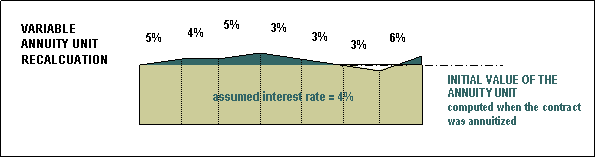
Each variable annuity contract will outline the formula used to determine annuity unit values. Some contracts may rely solely on investment experience (how the portfolio performed versus the AIR), while formulas in other contracts may also reflect mortality and expense experience.
Equity Indexed Annuities (EIAs)
Equity indexed annuities (EIAs) or equity indexed contracts (EICs) are a type of fixed annuity that offer the potential for higher credited rates of return than their traditional counterparts while also guaranteeing the owner’s principal. The interest credited to an EIA is tied to increases in a specific equity or stock index — most commonly the S&P 500 Composite Stock Price Index. Underlying the contract for the duration of its term is a minimum guaranteed rate, usually 3 or 4 percent, so a certain rate of growth is guaranteed. When increases in the index produce gains greater than the minimum rate, that gain becomes the basis for the interest credited to the annuity. At the end of the contract’s term (usually five to ten years), the annuity will be credited with the greater of the guaranteed minimum value or the indexed value.
Like a fixed annuity, investments are held in the annuity company’s general assets, not a separate account. Unlike fixed annuities, the rate of interest credited to an EIC is the greater of a minimum rate or the gain on a specified index — based on a predetermined formula rather than the rate the annuity company chooses to pay. Another key difference: all EICs have a stated term or duration; other types of annuities do not.
EIAs bridge the gap between traditional guaranteed fixed annuities (subject to inflation risk) and variable annuities (subject to market risk). With an EIA, individuals who do not want to risk principal can still receive market-based earnings likely to be higher than those offered by traditional fixed products.
Indexing Methods
The interest rates credited to equity indexed annuities are based on changes to the underlying index. Each contract spells out how the index’s performance translates into the interest rate paid. There are two broad categories:
Example: Index starts at 1,300. End of year 1: 1,430 (+10%). $100,000 grows to $110,000. End of year 2: 1,350 (negative — ignored; value stays $110,000). End of year 3: 1,250 (negative — ignored; value stays $110,000). End of year 4: 1,275 (+2% over prior year). Cash value grows 2% to $112,200 — even though the index is below its original starting value.
Many point-to-point contracts include a “high water mark” provision — the company looks at the value of the index on each anniversary date, and the index’s highest value on those dates determines the gain credited. This protects investors from a significant decline in the later years. Some contracts also average index values over time rather than selecting a single value at a specific point. Averaging prevents the investor from being locked into the lowest index point of the year but also guarantees they will never hit the highest point.
Equity Indexed Annuities vs. Index Mutual Funds
At first sight, an annual reset EIC may appear to always outperform the index. In the bear market example above, an investment in stocks mirroring the S&P 500 would have experienced a loss (from 1,300 to 1,275), while the annual reset annuity grew from $100,000 to $112,200. But that simple analysis overlooks key differences.
Investors in an indexed mutual fund or ETF (such as SPDRs®) receive dividends from their investments. Those dividends are not factored into most EIC valuations — the index measures only changes in underlying stock prices, not the total return (capital appreciation + dividends). Historically, dividends account for approximately one-third of a stock portfolio’s total return.
Standard & Poor’s does calculate a “total return” index for the S&P 500 that includes dividend payments, commonly used to compare mutual fund performance to the general market. Most EICs use the regular (no-dividend) S&P 500, not the “total return” index. Financial advisors should know which index the contract uses.
“Moving Parts” — EIC Limitations
Adding to the complexity of equity indexed annuities are various limitations on how the index’s gains and losses translate into changes in the contract’s cash values. These limitations are referred to as the “moving parts” of the annuity. Each contract will have its own unique set of moving parts, and small variations can significantly affect the overall return the annuity owner actually receives.
Example — index cap: An annual reset EIC has 80% participation and a 12% index cap. If the index gains 10%, the full gain is used (below the cap) and 80% participation yields 8% credited. If the index gains 20%, only 12% is used (the cap applies), further reduced by 80% participation to 9.6%.
Example — interest rate cap: Same scenario, but with an interest rate cap. A 20% index gain × 80% participation = 16%, which exceeds the 12% cap — so the contract credits 12% (vs. 9.6% under the index cap).
EIA Summary
The primary purpose of an equity index annuity is accumulation. Unlike other annuity contracts, an equity indexed contract has a “maturity” date. At the end of the contract period, the accumulated value can be taken as a lump sum or in the form of annuity payments.
Some contracts offer multiple indexes simultaneously, often combining indexed and declared-rate funds in “cash value strategies” contracts. The insurer may automatically allocate premiums to the different indices, or leave that to the discretion of the contract owner. Some allow the allocation to be changed after issue, operating similarly to variable contracts with multiple investment choices — but unlike variable annuities, EIAs are set up in the general account (without a separate account).